Skip to content Skip to left sidebar Skip to right sidebar Skip to footer

Environment

Page 2 of 6
1 2 3 4 6

Unlocking Opportunities: A Finima Youth’s Guide to the NLNG Train 7 Project and Beyond

For years, it has been the talk of the town, a buzz of anticipation felt across Bonny Island. The Nigeria LNG (NLNG) Train 7 project is more than just another industrial expansion; it is a monumental undertaking, a promise of jobs, and a beacon of opportunity. For the youth of Finima, the primary host community, this project is happening right on your doorstep, representing the single greatest chance in a generation to build a rewarding career and secure a prosperous future.

But with great opportunity comes great confusion. How do you go from hearing about the project to actually working on it? What skills are they really looking for? How do you avoid the scams and false promises that always surround major projects? It can feel like trying to find a specific door in a massive, unmarked building.

This guide is your key. This is your detailed, practical, no-nonsense roadmap to unlocking the opportunities within the Train 7 project and, more importantly, building a career that will last long after the project is complete. It is time to replace uncertainty with a clear, actionable plan.


Part 1: Understanding Your Advantage – The Power of Local Content

Before you even think about skills or CVs, you must understand a fundamental principle that gives you a significant advantage: Local Content. This isn’t just a buzzword; it is a legal and operational framework designed to ensure that projects like Train 7 deliver tangible benefits to Nigerians, with a special focus on host communities like Finima.

The cornerstone of this framework is the Nigerian Oil and Gas Industry Content Development (NOGICD) Act. In simple terms, this law mandates that companies operating in the oil and gas sector must prioritise the use of Nigerian workers, contractors, and services. It was created to stop the old practice of major projects being built almost entirely by foreign experts, leaving local communities on the sidelines.

Flowing from this Act are Community Content Guidelines (CCG). These are specific agreements worked out between NLNG, its contractors, and the host communities. They detail how the broad principles of the NOGICD Act will be applied on the ground. The CCG sets out specific quotas and preferences for the employment of community indigenes, particularly for roles that do not require highly specialised, globally scarce expertise.

What does this mean for YOU?

It means you are not just another applicant in a vast sea of jobseekers. As an indigene of Finima, you are in a legally recognised priority group. When the main contractors for Train 7—a consortium known as the SCD JV (Saipem, Chiyoda, and Daewoo)—need to hire a welder, a scaffolder, an administrator, or a safety officer, they are obligated by law and by their agreements to look for qualified candidates from Finima first.

However, the key word is qualified. The law gives you the right of first refusal, but it does not guarantee a job if you do not have the required skills. Your advantage is the opportunity; your responsibility is to be prepared. This is where your journey truly begins.


Part 2: The In-Demand Skills – What You Need to Learn Now

Forget generic qualifications. Industrial construction projects on the scale of Train 7 require a specific portfolio of technical and vocational skills. If you want to be a valuable candidate, you need to focus on acquiring skills that are in high demand right now. These can be broken down into key categories.

A. Skilled Trades and Vocations: The Backbone of the Project

These are the hands-on roles that physically build the project. They are consistently in high demand and offer excellent career progression.

  • Welding (and Pipe Fitting): This is arguably the most sought-after trade. Projects like Train 7 involve connecting thousands of kilometres of pipes. Basic welding is good, but expertise in specialised techniques like TIG (Tungsten Inert Gas) welding and Arc welding for industrial pipes will place you at the top of the list. Pipe fitters, who measure, cut, and prepare the pipes for welding, work hand-in-hand with welders and are equally crucial.
  • Scaffolding: No construction can happen at height without safe and secure scaffolding. Certified scaffolders (basic and advanced) who can erect, modify, and dismantle complex structures are essential for the safety and progress of the entire project.
  • Electrical Installation & Instrumentation: Every part of a modern gas plant runs on electricity and is controlled by complex instruments. Certified electricians who can safely run industrial cables, install panels, and connect equipment are vital. Instrumentation fitters who can install and calibrate control devices are also a highly specialised and sought-after group.
  • Crane and Heavy Equipment Operation: Operating mobile cranes, forklifts, and excavators requires specific training and certification. A certified crane operator is one of the most visible and responsible roles on a construction site.

Image 1: A focused group of young Nigerian men and women in a vocational training centre. The image shows a bright, modern workshop. In the foreground, a young woman wearing a protective helmet and welding mask is carefully practising TIG welding on a piece of pipe, sparks flying. Behind her, a qualified instructor in overalls is guiding a young man who is looking at a complex electrical panel. The atmosphere is one of serious learning, skill acquisition, and empowerment.


B. Essential Support Roles: Keeping the Project Moving

Not everyone can be a welder. A project of this magnitude needs a huge team of support staff to function efficiently and safely.

  • Health, Safety, and Environment (HSE): Safety is the number one priority on any world-class construction site. A basic HSE certification (Level 1, 2, and 3) is one of the most valuable entry-level qualifications you can obtain. It opens doors to roles like Safety Officer, Fire Watcher, and Permit-to-Work Coordinator.
  • Logistics and Supply Chain Support: Imagine the sheer volume of materials—pipes, cables, cement, equipment—that need to be received, stored, and delivered to the right location on site at the right time. Roles in materials control, warehouse operation, and logistics coordination are critical.
  • Administration and Document Control: Major projects generate mountains of paperwork, from technical drawings to work permits and reports. Meticulous and organised individuals are needed for administrative support and document control roles to keep the project information flowing correctly.

C. Professional and Technical Roles: The Brains of the Operation

For those with higher education or specialised experience, there are numerous opportunities.

  • Engineering: Graduates in Mechanical, Civil, Electrical, and Chemical Engineering are needed for roles in supervision, quality control, and project management.
  • Quality Assurance / Quality Control (QA/QC): These are the inspectors who ensure that all work, especially welding and installation, meets the required international standards. A certification in QA/QC can lead to a highly respected and well-paid career.
  • IT Support: A modern construction site is heavily reliant on technology, from network connectivity to specialised software. IT professionals are needed to keep these systems running smoothly.

Part 3: Your Four-Step Action Plan – How to Get Hired

Knowing what skills are needed is only half the battle. You now need a concrete plan to make yourself the ideal candidate.

Step 1: Get Certified – Your Proof of Competence

In the industrial world, your word is not enough. You must have official certificates to prove you are trained and competent.

  • Identify Recognised Centres: Invest in your future by enrolling in a reputable vocational training centre. Look for institutions recognised by industry bodies, such as the Nigerian Institute of Welding (NIW). Don’t be tempted by cheap, unaccredited “certificate mills.”
  • Focus on Your Chosen Trade: Decide which skill you want to acquire and pursue the relevant certifications. For HSE, look for qualifications from bodies like NEBOSH or IOSH, which are globally recognised.
  • Document Everything: Keep all your certificates, training records, and qualifications in a neat, professional portfolio.

Step 2: Build a Professional CV – Your Marketing Document

Your Curriculum Vitae (CV) is the first impression a recruiter will have of you. It must be professional, clear, and tailored to the job you want.

  • Keep it Clean and Simple: Use a clear font and a simple layout. Focus on readability. Limit it to one or two pages.
  • Start with Your Contact Details: Your name, phone number, and a professional email address should be at the very top.
  • List Your Certifications First: For industrial roles, your technical certifications are more important than your academic history. List them clearly near the top of your CV.
  • Use Action Words: Describe any experience you have using strong verbs. Instead of “Was part of a team,” write “Collaborated with a team to successfully complete…”
  • Proofread, Proofread, Proofread: A single spelling or grammar mistake can get your CV thrown in the bin. Read it over carefully, and ask someone else to check it for you.

Image 2: A confident, professional young Nigerian woman holding her CV. The image shows a young woman in her mid-20s, dressed in a smart blouse. She is standing against a plain, well-lit background. She is holding a crisp, printed CV and looking directly at the camera with a slight, confident smile. Her expression is one of hope, readiness, and professionalism, embodying the ideal job applicant


Step 3: Look in the Right Places – The Official Channels

To avoid scams, you must use the official recruitment channels.

  • The Main Contractors (EPCs): The primary employer for Train 7 construction is the SCD JV (Saipem, Chiyoda, Daewoo). Monitor their official career websites. Do not pay anyone who claims they can get you a job with them. All official recruitment is free.
  • Community Portals: Liaise with the official community bodies tasked with interfacing on employment. This could be the Finima Capacity Development Committee (FCDC) or the Finima Youth Congress (FYC). They are the official channels for receiving information and submitting CVs for community-specific roles. They will help you filter out fraudulent “agents.”

Step 4: Think Beyond Train 7 – Build a Lifelong Career

This is the most important step of all. Do not view Train 7 as a one-time job; view it as a world-class training ground. The skills you acquire here are not just “Train 7 skills”; they are globally recognised industrial skills.

  • Gain Experience: Once on the project, be a sponge. Learn everything you can. Show up on time, work hard, and maintain a positive attitude.
  • Network Professionally: Build good relationships with your supervisors and colleagues. These connections can lead to future opportunities.
  • The Bigger Picture: A certified industrial welder or a qualified HSE officer from the Train 7 project can go on to work on other major projects in the Niger Delta, in the Nigerian maritime industry, or even internationally. The end of the Train 7 construction phase should be the beginning of your long and successful career, not the end of a job.

Image 3: A wide, inspiring shot of a major industrial construction site at dawn. The image shows the silhouette of a massive industrial plant under construction, similar to the NLNG facility. Cranes reach into the early morning sky, and the intricate network of scaffolding and pipes is visible. The rising sun creates a dramatic orange and purple glow on the horizon, symbolising a new day and new opportunities. The scale of the project conveys a sense of ambition and the vast potential for employment.


Conclusion: Your Future is in Your Hands

The NLNG Train 7 project is a generational opportunity, but it is not a lottery ticket. Success will not be handed to you; it must be earned through preparation, dedication, and strategic action. The doors are open for the youth of Finima in a way they are not for others, but it is up to you to acquire the skills and professionalism needed to walk through them.

Use this guide as your starting point. Invest in yourself by getting certified. Craft a CV that makes you proud. Use the official community channels to find your path. See this not just as a chance to get a job, but as a chance to build a career that will empower you, your family, and your community for decades to come.

The hum of construction on your doorstep is the sound of opportunity knocking. It is time to answer the door.

profile picture

Generate Audio Overview

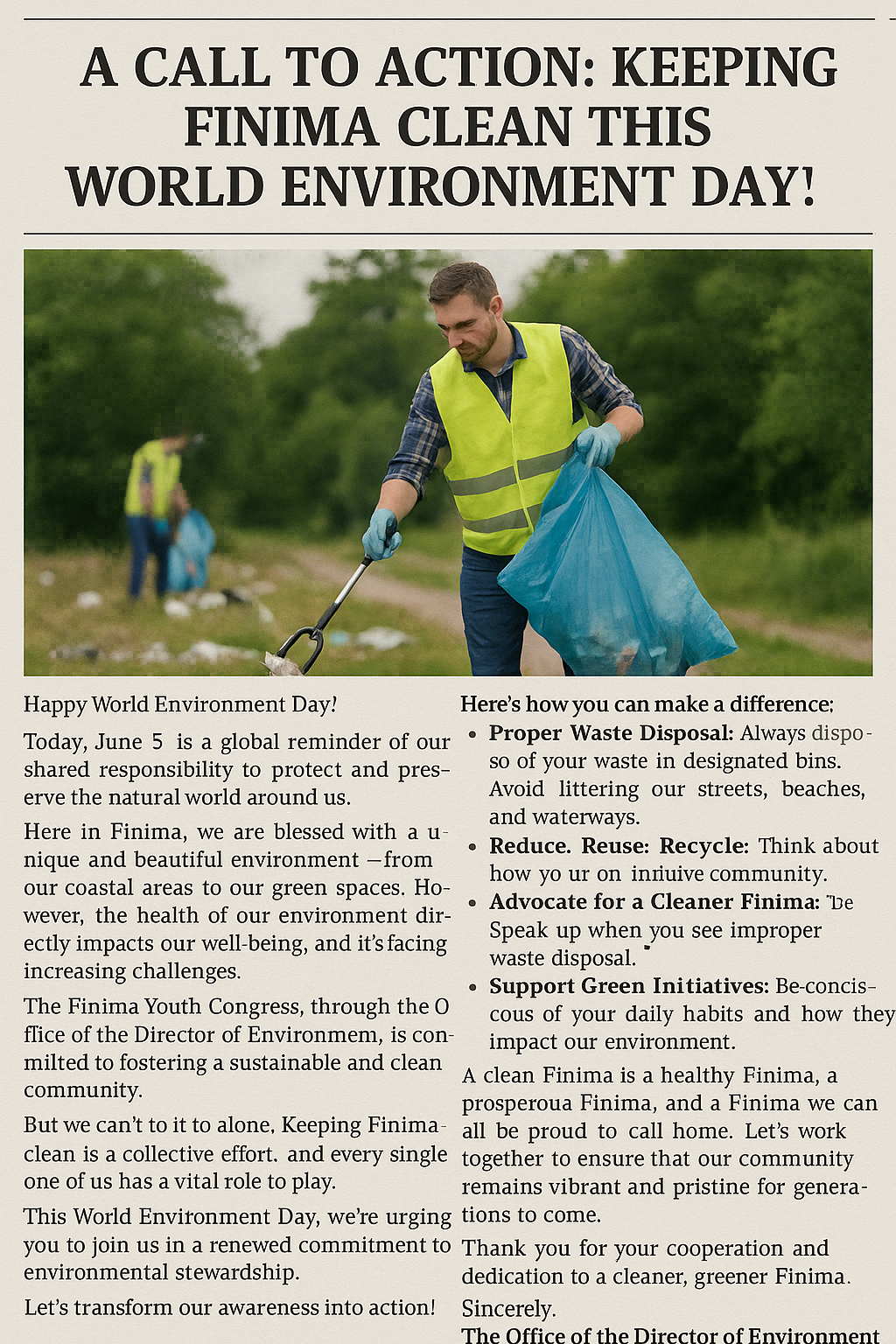
A Call to Action: Keeping Finima Clean This World Environment Day!

Finima Youth Congress Invites Every Resident to Embrace Environmental Responsibility


Happy World Environment Day! Today, 5 June 2025, reminds us all of our shared duty to protect Finima’s natural splendour. Nestled by the coast, Finima boasts pristine beaches, thriving wetlands and verdant community parks. Yet, like many growing towns, it now faces mounting environmental pressures—ranging from littered shorelines to overflowing bins. The Finima Youth Congress, through the Office of the Director of Environment, is spearheading a concerted campaign to keep our home clean. But lasting change requires collective effort: every household, trader, pupil and retiree has a part to play.

“Finima’s environment underpins our health, our economy and our sense of community,” notes the Director of Environment at the Youth Congress. “This World Environment Day, we must move beyond awareness to action—tidying our streets, safeguarding our waterways and nurturing our green spaces. Only then can we hand a healthier Finima down to our children.”

The State of Finima’s Environment

Finima’s coastal location has always been both a blessing and a responsibility. Fisherfolk rely on healthy waters for their livelihoods, while families flock to the beaches and community parks for relaxation and recreation. Mangrove stands buffer the town against tidal surges, while the local wetland supports diverse birdlife. These natural assets also attract eco-tourists, generating vital income for vendors and small businesses.

Yet as Finima expands, waste management struggles to keep pace. Market stalls and roadside kiosks often lack adequate bins; as a result, sachet packets, plastic bottles and food wrappers frequently end up on footpaths or, worse, clogging drains. During the rainy season, blocked drainage channels lead to flooding and waterborne diseases. Meanwhile, coastal litter tarnishes the town’s appeal, threatening both marine ecosystems and local pride.

Turning Awareness into Action

Recognising these challenges, the Finima Youth Congress launched the “Finima Clean” campaign on World Environment Day. Over the coming months, the initiative will focus on five key areas:

  1. Proper Waste Disposal
    Residents are urged to use the new network of waste bins installed across neighbourhoods. Households should separate biodegradable from non-biodegradable items: organic waste can be composted, while plastics, metals, paper and glass belong in clearly labelled recycling bins. Market traders are also encouraged to secure refuse sacks and avoid dumping waste on sidewalks.
  2. Reduce, Reuse, Recycle
    At the heart of the campaign lies the familiar three-step approach. Simple adjustments—like refilling metal water flasks instead of buying single-use bottles, repurposing old containers for storage, and donating unwanted clothing—can significantly reduce waste. Schools in Finima have established recycling clubs where pupils learn to sort materials and craft upcycled items for display at local exhibitions.
  3. Participate in Community Clean-up Events
    Beginning this month, fortnightly neighbourhood clean-ups will be coordinated by the Youth Congress. Volunteers of all ages—pupils, market traders, civil servants and retirees—will gather at designated assembly points with gloves and branded refuse bags to clear litter from streets, waterways and the coastline. The highlight will be a town-wide coastal clean-up on Saturday 14 June 2025, which anyone can join by registering online at the Finima Youth Congress Facebook page or at the Youth Congress office on Amadi Road.
  4. Advocate for a Cleaner Finima
    Each resident is a guardian of public space. If you witness illegal dumping, overflowing bins or fly-tipping, report it immediately to the Waste Management Unit via the dedicated hotline or the Finima Municipal Council’s website. Neighbourhood watch groups are forming environmental subcommittees to monitor local streets and liaise with municipal services. By speaking up, residents help deter repeat offenders and ensure timely waste collection.
  5. Support Green Initiatives
    Beyond waste management, the Youth Congress is partnering with the Finima Environmental Trust to fund community-led projects. The new “Green Grants” scheme offers small grants for initiatives such as installing rainwater harvesting tanks, planting native trees along road corridors and establishing solar-powered streetlights in neighbourhoods. Local businesses are invited to participate by offering incentives for customers who bring reusable bags, switch to eco-friendly packaging or adopt energy-efficient lighting.

Perspectives from Finima Residents

Rather than attributing fictional names to locals, the Youth Congress has gathered general feedback from participants in previous clean-up events. Their experiences illustrate the campaign’s growing momentum:

One lifelong fisherman described how plastic fragments had become entangled in his nets, affecting his catch. He explained that by joining a recent shoreline clean-up, he witnessed first-hand the positive impact of removing waste and encouraged fellow fishers to keep their beaches tidy.

A secondary-school teacher shared that, at her school, pupils now collect over 50 kilograms of plastic and paper each month. The school’s recycling club meets weekly to sort materials, create upcycled crafts for local exhibitions and raise awareness among peers. She believes that embedding environmental education in the curriculum will foster a generation committed to sustainable living.

A young café owner located near the beachfront described the shift to biodegradable plates and cups. Although some customers still left litter on the sand, she reported that her new signboards—placed next to waste bins—have prompted many to dispose of rubbish responsibly. She urged other businesses to follow suit by displaying clear instructions on proper waste disposal.

The National Context: Nigeria’s Environmental Challenges

Finima’s environmental efforts fit within Nigeria’s broader endeavour to address waste and pollution. Rapid population growth and urban migration have stretched municipal waste-collection systems. According to the National Environment Agency’s latest report, urban centres generate approximately 32 million tonnes of solid waste annually, yet only around 55 per cent is collected or treated via sanitary landfills. Coastal communities, in particular, face heightened risks from erosion and sea-level rise, aggravated by upstream deforestation and inadequate waste management.

Federal and state governments have introduced various programmes, such as waste-to-energy initiatives and national clean-up exercises. However, success ultimately depends on local engagement. Environmental economist Dr. Pius Ayodele observes that “grassroots action is indispensable. Policies on paper must be matched by community buy-in. Finima’s approach—combining youth leadership with practical clean-ups and educational drives—offers a blueprint for other coastal towns.”

How to Get Involved

The Finima Youth Congress has made it simple for anyone to participate:

  • Register for Clean-ups: Visit the official Finima Youth Congress Facebook page or drop by the Youth Congress office on Amadi Road to sign up. All volunteers will receive gloves, reflective vests and branded refuse bags on the day of each event.
  • Form or Join a Community Group: Neighbourhood watch committees can establish environmental sub-teams to monitor public spaces and report issues to municipal authorities.
  • Sponsor or Donate: Local businesses and individuals can support by providing water, snacks or equipment—such as gloves and litter-pick tools—for clean-up volunteers. Contact the Office of the Director of Environment to arrange sponsorship or donations.
  • Adopt Eco-friendly Habits at Home:
    • Compost kitchen scraps to enrich home gardens.
    • Fix dripping taps and collect rainwater for irrigation.
    • Unplug electrical appliances when not in use to conserve energy.

Each small step, multiplied across hundreds of households, can yield significant environmental benefits.

Measuring Progress and Ensuring Accountability

Transparency is central to the “Finima Clean” campaign. The Youth Congress will publish quarterly environmental reports, featuring key metrics:

  • Total Tonnes of Waste Collected: Recorded at each clean-up event and cumulatively.
  • Volunteer Participation: Tracked by age group and neighbourhood, highlighting community engagement.
  • Number of Saplings Planted and Maintained: Monitored in community gardens and along road corridors.
  • Reduction in Illegal Dumping Cases: Measured by comparing municipal records from early 2025 with subsequent quarters.

These reports, accessible on the Finima Youth Congress website and social media pages, will help identify successes and areas needing improvement. They will also inform future initiatives and ensure that residents can hold organisers accountable.

Looking Ahead: A Sustainable Vision for Finima

A globe whose ecosystems are resilient depends on a mosaic of local efforts—towns like Finima, where people recognise that their daily actions matter. When children evaluate the environment as part of their lessons, when market traders secure refuse bags and when beachgoers carry their litter home, the cumulative effect reshapes the town’s future. The Youth Congress envisions a Finima where:

  • Streets and beaches are routinely free of litter.
  • Recycling becomes second nature in homes and schools.
  • Urban greenery flourishes, with native trees lining avenues and community gardens harvesting produce.
  • Clean-up events are celebrated occasions, bringing together elders, youths and novices alike.

In such a Finima, health outcomes improve. Fewer blockages in drains mean less flooding and reduced risk of diseases. Eco-tourism thrives as visitors encounter unspoilt beaches. Local fisheries rebound as marine life thrives in cleaner waters. Businesses gain from a town renowned for its cleanliness, attracting customers who value responsible practices.

As the Director of Environment at the Finima Youth Congress aptly states: “Our collective efforts will write the next chapter for Finima—one of environmental resilience, community pride and sustainable growth. This World Environment Day, let us pledge to keep our homes, streets, beaches and waterways tidy. Let every piece of litter you pick up, every seedling you plant, and every conversation you have about ecology become a stitch in the tapestry of a greener Finima.”

Conclusion

World Environment Day may be an annual observance, but its spirit must permeate every day. The Finima Youth Congress invites every resident—school pupil, market vendor, civil servant, retiree—to embrace this call to action. Proper waste disposal, participation in clean-up drives, support for green initiatives and advocacy for a cleaner town are not optional extras; they are essential responsibilities. Only through collective endeavour can we ensure Finima remains a place where nature and community thrive in harmony.

Thank you for your dedication to a cleaner, greener Finima. Your commitment today will shape the legacy we hand to tomorrow’s generations. Let us stand together, united in purpose, as stewards of our shared environment.

— The Office of the Director of Environment, Finima Youth Congress


Featured Images:

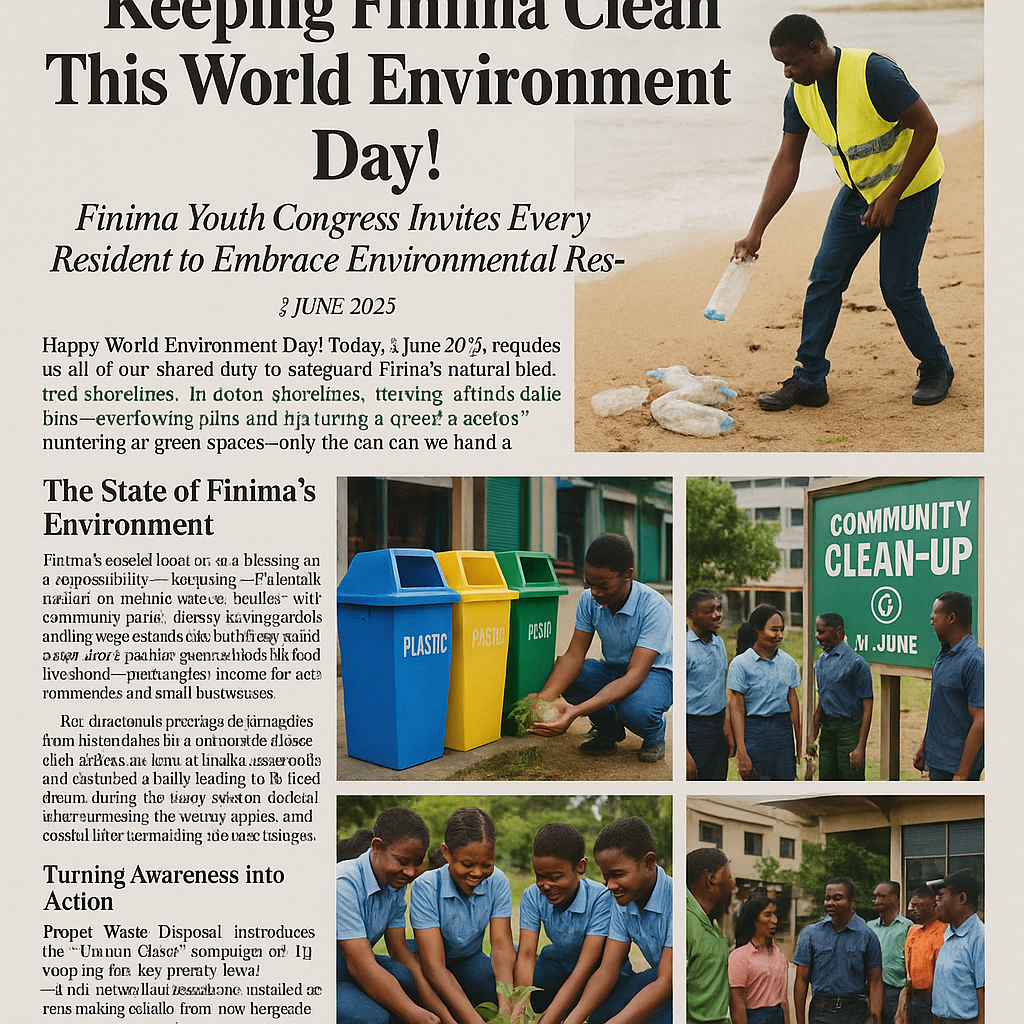
  1. A volunteer in a reflective vest collects plastic bottles along Finima’s shoreline during a coastal clean-up.
  2. Colourful recycling bins placed outside a local market, underscoring the “Reduce, Reuse, Recycle” message.
  3. A group of schoolchildren planting a sapling in the community garden, exemplifying youth-led green initiatives.
  4. Members of the Youth Congress coordinating with municipal waste officers beneath a billboard promoting the 14 June 2025 clean-up drive.

Mecklenburg Holstein beach, baltic sea

The Environment: Our Shared Responsibility

Introduction

The environment is the foundation of life on Earth, encompassing all living and non-living things that surround us. From the air we breathe to the water we drink, every aspect of our existence depends on a healthy and balanced ecosystem. However, human activities have significantly impacted the environment, leading to climate change, pollution, deforestation, and loss of biodiversity. This blog post explores the importance of the environment, the challenges it faces, and what we can do to protect it for future generations.

What is the Environment?

The environment refers to the natural world, including the atmosphere, land, water, plants, animals, and microorganisms. It consists of two main components:

  1. Biotic Factors—Living organisms such as plants, animals, and humans.
  2. Abiotic Factors—Non-living elements like air, water, soil, and sunlight.

These components interact in complex ways to sustain life. A healthy environment ensures clean air, fertile soil, fresh water, and a stable climate—essential for human survival and well-being.

Why is the Environment Important?

1. Supports Life

The environment provides the basic necessities for life—oxygen, food, water, and shelter. Without a stable ecosystem, human survival would be impossible.

2. Regulates Climate

Forests, oceans, and other natural systems help regulate the Earth’s temperature by absorbing carbon dioxide and releasing oxygen. Deforestation and pollution disrupt this balance, leading to global warming.

3. Sustains Biodiversity

Millions of species depend on diverse ecosystems for survival. Biodiversity ensures resilience against diseases, supports agriculture, and maintains ecological balance.

4. Economic Benefits

Natural resources like timber, minerals, and fossil fuels drive economies. Sustainable management ensures long-term availability.

5. Mental and Physical Health

Access to clean air, green spaces, and nature improves mental health, reduces stress, and enhances overall quality of life.

Major Environmental Challenges

Despite its importance, the environment faces severe threats due to human activities:

1. Climate Change

Burning fossil fuels releases greenhouse gases, trapping heat in the atmosphere. This leads to rising temperatures, extreme weather, and rising sea levels.

2. Pollution

  • Air Pollution—Caused by vehicle emissions, industrial waste, and burning fossil fuels.
  • Water Pollution—Results from chemical spills, plastic waste, and untreated sewage.
  • Soil Pollution—Caused by pesticides, industrial waste, and deforestation.

3. Deforestation

Forests are cleared for agriculture, logging, and urban expansion, leading to habitat loss, soil erosion, and increased CO₂ levels.

4. Loss of Biodiversity

Species extinction rates are 1,000 times higher than natural levels due to habitat destruction, pollution, and climate change.

5. Waste Management

Plastic waste, electronic waste, and non-biodegradable materials pollute land and oceans, harming wildlife and ecosystems.

How Can We Protect the Environment?

While the challenges are immense, collective action can make a difference. Here are some ways to contribute:

1. Reduce, Reuse, Recycle

  • Minimize waste by using reusable products.
  • Recycle paper, plastic, glass, and metals.
  • Compost organic waste to reduce landfill use.

2. Conserve Energy

  • Use energy-efficient appliances.
  • Switch to renewable energy sources like solar or wind power.
  • Turn off lights and unplug devices when not in use.

3. Save Water

  • Fix leaks and use water-saving fixtures.
  • Avoid excessive water use in daily activities.

4. Support Sustainable Practices

  • Buy locally sourced and organic products.
  • Reduce meat consumption to lower carbon footprints.
  • Avoid single-use plastics.

5. Plant Trees and Restore Ecosystems

  • Participate in tree-planting initiatives.
  • Support conservation projects for wildlife and forests.

6. Advocate for Policy Changes

  • Support laws that reduce pollution and protect natural habitats.
  • Vote for leaders who prioritize environmental sustainability.

Conclusion

The environment is not just a resource—it’s our home. Protecting it requires immediate action from individuals, governments, and businesses. By adopting sustainable habits, reducing waste, and advocating for change, we can ensure a healthier planet for future generations. Every small effort counts, and together, we can make a lasting impact.

Let’s commit to preserving the environment today—for a greener, cleaner, and more sustainable tomorrow.

What steps are you taking to protect the environment? Share your thoughts in the comments! 🌍💚

Page 2 of 6
1 2 3 4 6