Origins of Finima: From Ancient Ijaw Settlement to IOC Host Community
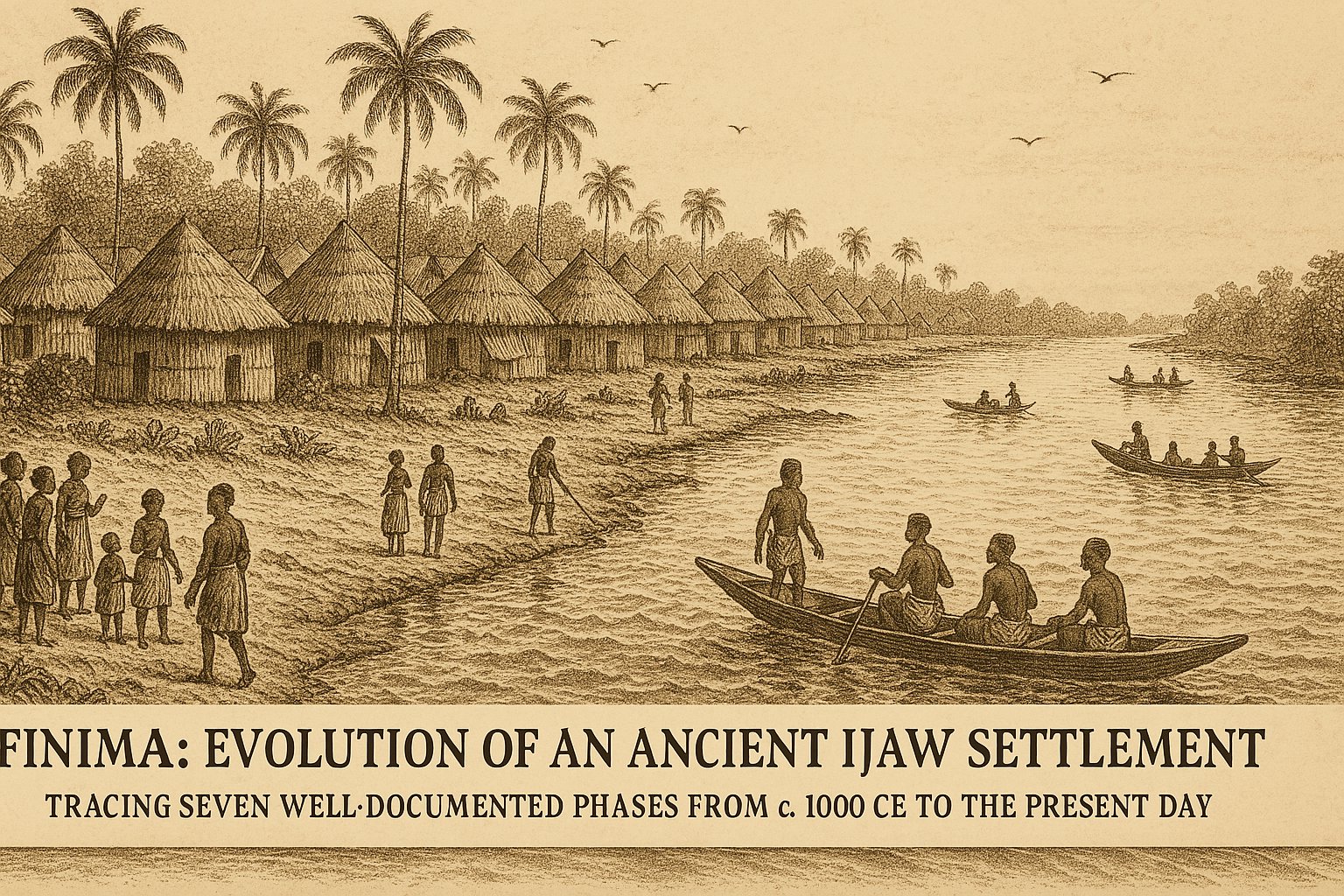
Finima, nestled on the southern coast of Bonny Island in Rivers State, Nigeria, stands as one of the most ancient Ijaw settlements in the Niger Delta region. Established around 1000 AD, it predates the urban emergence of Bonny Town by several centuries. Originally a thriving riverine community engaged in fishing and trade, Finima’s strategic location along the creeks of Bonny Creek fostered early commerce in fish, salt, and forest products. Over time, its deep-rooted kinship bonds and advantageous geography paved the way for its transformation into a major host community for multinational oil corporations, notably Shell’s Bonny Terminal and the Nigeria LNG (NLNG) gas-liquefaction complex. This comprehensive article delves into Finima’s origins, tracing its journey through ancient settlement, colonial encounters, and industrial modernity, highlighting the community’s enduring cultural and economic significance.
Founding of Finima and the Kinship of Okuma (Circa 1000 AD)
Finima’s origins trace back to the early 2nd millennium AD with the settlement of the descendants of Okuma, a revered patriarch from Ebeni Toru along the Isedeni River in what is today Kolokuma Local Government Area of Bayelsa State. Okuma’s lineage branched into four main sons—Kongo, Opuamakuba, Alagbariya, and Asikunoma—each establishing distinct riverine communities within the Niger Delta.
While Alagbariya founded Okoloma, the precursor to modern Bonny Town in the 13th century, it was Kongo’s descendants who settled Finima several centuries earlier. This timeline positions Finima as arguably the oldest established community on Bonny Island, with archaeological and genealogical evidence supporting its precedence over Bonny Town’s urbanization.
The community’s early economy centered around fishing, salt production, and trading forest products, leveraging its network of creeks and waterways. These activities not only sustained the inhabitants but also forged intricate kinship ties that reinforced social cohesion and facilitated commerce within and beyond the Niger Delta.
Finima’s Role in Pre-Colonial Trade and Early European Contact (15th–18th Centuries)
Finima’s strategic coastal location along the Atlantic Ocean made it a critical hub in pre-colonial trans-Saharan and coastal trade networks. By the 15th century, Portuguese explorers had begun frequenting the Bonny area, engaging in exchanges that introduced European goods such as cloth, metalwares, and spirits in return for palm oil, ivory, and other local commodities.
Traders from Finima actively participated in these exchanges, utilizing their adept knowledge of the waterways and regional markets. British maritime records from the late 18th century document flotillas linked to Finima transporting palm kernels and salted fish to West African trading posts like Fort Jacqueville on the Gold Coast, highlighting the community’s extensive trading reach.
The integration of Finima into these early global trade circuits not only enhanced its economic stature but also introduced new cultural influences and technologies, setting the stage for its eventual interactions with colonial powers and multinational corporations.
The Palm Oil Boom and Colonial Concessions in the 19th Century
The decline of the trans-Atlantic slave trade by the early 19th century prompted Finima and neighboring Bonny communities to pivot towards palm oil and kernel exports, commodities that became central to the Niger Delta’s economy. By 1860, European commercial records, particularly from Liverpool and Hamburg, noted shipments of approximately 15,000 tonnes of palm kernels annually, sourced in part from Finima traders.
This economic shift attracted increased European interest, culminating in the establishment of the Oil Rivers Protectorate in 1886. The protectorate formalized concessionary rights for European firms along the waterways of Bonny Creek, effectively setting legal frameworks that would later facilitate oil exploration and exploitation.
Finima’s involvement in the palm oil trade consolidated its reputation as a significant maritime trading community and laid foundational ties with emerging colonial authorities, which would influence its future socio-economic trajectory.
Shell’s Arrival and the Establishment of the Bonny Terminal (1936–1961)
The 20th century marked a transformative period for Finima with the arrival of Shell D’Arcy, which secured Nigeria’s first exploration license in 1938. Following the landmark oil discovery at Oloibiri in 1956, Shell recognized Finima’s deepwater advantages and proximity to Bonny Creek as ideal for oil export infrastructure.
Negotiations with Finima’s traditional chiefs enabled Shell-BP to acquire land access, and by July 1958, dredging operations commenced to prepare the site for the construction of the Bonny Terminal. This facility, commissioned on April 4, 1961, was equipped to berth large tankers of up to 70,000 tons, marking a new industrial era for the community.
The terminal’s development introduced pipelines, expatriate residential camps, and a surge in labor demand, attracting workers from Finima and surrounding areas. This industrialization significantly altered the community’s shoreline and socio-economic fabric, embedding Finima within Nigeria’s burgeoning oil economy.
The Nigeria LNG (NLNG) Project and the Gas-Liquefaction Era (1989–1999)
In 1989, Nigeria LNG Limited (NLNG) was incorporated as a joint venture among the Nigerian National Petroleum Corporation (NNPC), Shell, Total, and ExxonMobil. The initiative aimed to monetize associated natural gas reserves through liquefaction and export, positioning Finima as a strategic site for the project due to its coastal accessibility and existing infrastructure.
Comprehensive Environmental Impact Assessments conducted under the 1992 Federal Environmental Protection Agency Act identified Finima as the preferred location for constructing the LNG liquefaction trains. Construction of the first three trains began in 1995, culminating in the loading of the inaugural commercial LNG cargo on March 27, 1999.
Alongside industrial development, NLNG invested in environmental conservation by establishing the 1,000-hectare Finima Nature Park. This initiative, in partnership with the Nigerian Conservation Foundation, aimed to protect critical mangrove ecosystems and freshwater swamps, balancing industrial growth with ecological stewardship.
Resettlement and Socioeconomic Transformation (1998–2005)
The expansive footprint of the NLNG project necessitated the largest involuntary resettlement in Bonny Island’s history. Between 1998 and 2001, NNPC funded the construction of 500 modern housing units equipped with electricity and potable water to accommodate displaced Finima residents, representing a significant shift from traditional housing patterns.
This resettlement altered Finima’s socio-economic landscape, transitioning many inhabitants from subsistence fishing and trading livelihoods to wage employment opportunities linked to the oil and gas industry. While this brought improved infrastructure and income prospects, it also introduced challenges related to cultural adaptation and community cohesion.
Local governance and traditional leadership played pivotal roles in managing these changes, striving to balance modernization with the preservation of Finima’s rich cultural heritage and social structures.
Finima Today: Balancing Heritage and Industrial Progress
Today, Finima stands as a unique community where ancient Ijaw traditions coexist alongside state-of-the-art oil and gas facilities. Its identity as the oldest settlement on Bonny Island is celebrated through cultural festivals, oral histories, and preservation of traditional practices.
The presence of multinational corporations such as Shell and NLNG continues to influence Finima’s economy, providing employment and infrastructural development, while also necessitating ongoing dialogue around environmental protection and equitable resource sharing.
Community initiatives, including environmental conservation efforts and educational programs, reflect Finima’s commitment to sustainable development, ensuring that progress does not come at the expense of its historical legacy or ecological integrity.
Conclusion
The history of Finima encapsulates a remarkable journey from an ancient Ijaw fishing and trading community to a pivotal host for Nigeria’s oil and gas industry. Its enduring kinship structures, strategic coastal position, and adaptive resilience have enabled it to navigate centuries of change—from early European trade contacts and colonial economic shifts to modern industrialization and environmental conservation. As Finima continues to evolve, it stands as a testament to the dynamic interplay between heritage preservation and economic progress within the Niger Delta. Understanding its origins and transformation offers valuable insights into the complexities of community development amidst the pressures of globalization and resource extraction.
Discover more from FINIMA
Subscribe to get the latest posts sent to your email.
1 Comment
Thank you for sharing