Italian scholars examine Leonardo da Vinci’s handwritten text on student’s drawing, contents unknown: Chunichi Shimbun Web
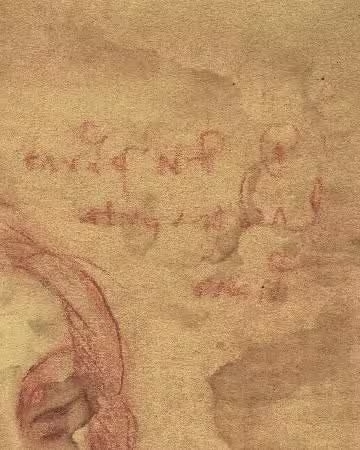
In a fascinating discovery that bridges art history and forensic scholarship, Italian experts have identified handwritten text on a student’s drawing that is likely penned by Leonardo da Vinci himself. The text appears on a red charcoal sketch depicting a young woman’s torso, attributed to Cesare da Sesto, one of Da Vinci’s notable pupils. Despite high hopes, the exact content of the notes remains unknown, adding a layer of mystery to this remarkable artifact. This article delves into the discovery, the historical context, the analysis process, and the significance of this finding for Renaissance art studies.
Discovery and Historical Context of the Drawing
The drawing in question, a red charcoal depiction of a young woman’s torso, was rediscovered in the 1990s after circulating among Swiss antiquities dealers. Its provenance traces back to the early 16th century, linking it to the Renaissance period when Leonardo da Vinci’s influence was profound. The artwork was eventually acquired by a Swiss art collector who brought it to the attention of Italian experts.
In 2001, Carlo Pedretti, a renowned Leonardo da Vinci scholar, identified the piece as the work of Cesare da Sesto, a distinguished pupil of Da Vinci. Cesare was known for closely following Leonardo’s techniques and style, making the drawing a valuable piece for understanding the master’s artistic legacy through his students.
This historical context is crucial as it places the drawing within Da Vinci’s circle, where handwritten annotations could have served as instructional notes or personal commentary. The presence of such text opens new avenues for exploring how Leonardo communicated his artistic ideas beyond his own direct works.
Identification of Leonardo da Vinci’s Handwriting
The handwritten text was examined by a committee specializing in historical, cultural, and environmental assets, collaborating with the National Museum of Natural History. Their expertise in paleography and Renaissance manuscripts was essential in authenticating the handwriting style as consistent with Leonardo’s documented scripts.
Silvano Vincetti, who led the appraisal, emphasized the significance of the find, stating that the handwriting bears all the hallmarks of Da Vinci’s unique mirror writing—a technique he famously used. This discovery adds to the limited corpus of Leonardo’s known handwritten materials, making it a rare and precious artifact.
Despite the handwriting’s apparent authenticity, scholars have yet to decipher the contents, as the text is faint and partially obscured by the charcoal medium. The difficulty in interpretation has led to ongoing debates and efforts employing advanced imaging technology and linguistic analysis.
Challenges in Deciphering the Handwritten Text
The primary challenge in interpreting the text lies in its fragile condition and the medium on which it is written. The red charcoal drawing’s surface does not provide a clear contrast for the ink or pencil used for the notes, making traditional reading methods ineffective.
Additionally, Leonardo’s use of mirror writing, combined with archaic Italian and Latin phrases, complicates translation efforts. His tendency to write in shorthand and integrate sketches within his notes further obscures the intended meaning.
To overcome these hurdles, scholars are applying multispectral imaging and digital enhancement techniques. These technologies aim to reveal hidden details invisible to the naked eye, hoping to unlock the text’s secrets and provide insight into Da Vinci’s thoughts or instructions.
The Role of Cesare da Sesto and Leonardo’s Students
Cesare da Sesto was one of Leonardo da Vinci’s most prominent pupils, known for adopting and disseminating his master’s artistic innovations. His works often reflect Leonardo’s anatomical precision and compositional balance, making this drawing an important link in the educational lineage.
The presence of Leonardo’s notes on a student’s drawing suggests a direct mentorship approach, where the master provided guidance through annotations. This method would have been invaluable for students to refine their technique and understand Leonardo’s complex artistic philosophy.
Understanding this dynamic sheds light on Renaissance art pedagogy and the collaborative environment of Leonardo’s workshop. It also highlights how knowledge was transmitted, preserved, and sometimes hidden within artworks, awaiting rediscovery centuries later.
Technological Advances Assisting the Investigation
Modern technology plays a pivotal role in the ongoing analysis of the handwritten text. Multispectral imaging allows researchers to capture images across different wavelengths, enhancing faded or erased writing without damaging the original drawing.
3D scanning and digital reconstruction help visualize the surface textures and ink deposits, providing clues about the writing instrument and pressure applied. These details assist in confirming authenticity and understanding Leonardo’s writing habits.
Collaborations between art historians, forensic experts, and computer scientists are pushing the boundaries of what can be revealed from ancient manuscripts. Such interdisciplinary efforts increase the chances of eventually deciphering the text and contextualizing it within Da Vinci’s oeuvre.
Implications for Renaissance Art and Scholarship
Should the text be deciphered, it could offer unprecedented insights into Leonardo’s teaching methods, artistic intentions, or personal reflections. This would enrich our understanding of Renaissance art and the intellectual environment of the period.
Furthermore, the discovery underscores the importance of revisiting lesser-known artworks and documents. Hidden annotations and marginalia can transform our perception of historical figures and their creative processes.
The find also exemplifies the enduring fascination with Leonardo da Vinci, whose genius continues to inspire research and captivate the public imagination. Each new fragment adds depth to the narrative of one of history’s greatest polymaths.
Future Prospects and Ongoing Research
The mystery surrounding the handwritten text remains unsolved, but researchers remain optimistic. Continued technological advances and collaborative international efforts promise to bring new findings in the near future.
Exhibitions and publications related to this discovery are anticipated to raise public awareness and generate funding for further study. Engaging the global scholarly community could accelerate progress toward decoding the notes.
Ultimately, this discovery reinforces the dynamic nature of art history, where even centuries-old artifacts can yield new knowledge. The story of Leonardo’s handwriting on a pupil’s drawing exemplifies the timeless quest for understanding artistic genius.
Conclusion
The recent identification of Leonardo da Vinci’s handwriting on a student’s red charcoal drawing has captivated scholars and art enthusiasts alike. While the contents of the notes remain a tantalizing mystery, the discovery itself enriches the narrative of Leonardo’s influence and teaching methods during the Renaissance. As technology and scholarship advance, there is hope that this enigmatic text will eventually be decoded, unlocking new dimensions in the study of one of history’s most extraordinary artists. This case exemplifies the enduring legacy of Leonardo da Vinci and the perpetual allure of uncovering secrets hidden within historical masterpieces.
Originally reported by chunichi.co.jp. Adapted for our readers.
Discover more from FINIMA
Subscribe to get the latest posts sent to your email.
0 Comments