Skip to content Skip to left sidebar Skip to right sidebar Skip to footer

Tag: community

Page 3 of 8
1 2 3 4 5 8

Unlocking Opportunities: A Finima Youth’s Guide to the NLNG Train 7 Project and Beyond

For years, it has been the talk of the town, a buzz of anticipation felt across Bonny Island. The Nigeria LNG (NLNG) Train 7 project is more than just another industrial expansion; it is a monumental undertaking, a promise of jobs, and a beacon of opportunity. For the youth of Finima, the primary host community, this project is happening right on your doorstep, representing the single greatest chance in a generation to build a rewarding career and secure a prosperous future.

But with great opportunity comes great confusion. How do you go from hearing about the project to actually working on it? What skills are they really looking for? How do you avoid the scams and false promises that always surround major projects? It can feel like trying to find a specific door in a massive, unmarked building.

This guide is your key. This is your detailed, practical, no-nonsense roadmap to unlocking the opportunities within the Train 7 project and, more importantly, building a career that will last long after the project is complete. It is time to replace uncertainty with a clear, actionable plan.


Part 1: Understanding Your Advantage – The Power of Local Content

Before you even think about skills or CVs, you must understand a fundamental principle that gives you a significant advantage: Local Content. This isn’t just a buzzword; it is a legal and operational framework designed to ensure that projects like Train 7 deliver tangible benefits to Nigerians, with a special focus on host communities like Finima.

The cornerstone of this framework is the Nigerian Oil and Gas Industry Content Development (NOGICD) Act. In simple terms, this law mandates that companies operating in the oil and gas sector must prioritise the use of Nigerian workers, contractors, and services. It was created to stop the old practice of major projects being built almost entirely by foreign experts, leaving local communities on the sidelines.

Flowing from this Act are Community Content Guidelines (CCG). These are specific agreements worked out between NLNG, its contractors, and the host communities. They detail how the broad principles of the NOGICD Act will be applied on the ground. The CCG sets out specific quotas and preferences for the employment of community indigenes, particularly for roles that do not require highly specialised, globally scarce expertise.

What does this mean for YOU?

It means you are not just another applicant in a vast sea of jobseekers. As an indigene of Finima, you are in a legally recognised priority group. When the main contractors for Train 7—a consortium known as the SCD JV (Saipem, Chiyoda, and Daewoo)—need to hire a welder, a scaffolder, an administrator, or a safety officer, they are obligated by law and by their agreements to look for qualified candidates from Finima first.

However, the key word is qualified. The law gives you the right of first refusal, but it does not guarantee a job if you do not have the required skills. Your advantage is the opportunity; your responsibility is to be prepared. This is where your journey truly begins.


Part 2: The In-Demand Skills – What You Need to Learn Now

Forget generic qualifications. Industrial construction projects on the scale of Train 7 require a specific portfolio of technical and vocational skills. If you want to be a valuable candidate, you need to focus on acquiring skills that are in high demand right now. These can be broken down into key categories.

A. Skilled Trades and Vocations: The Backbone of the Project

These are the hands-on roles that physically build the project. They are consistently in high demand and offer excellent career progression.

  • Welding (and Pipe Fitting): This is arguably the most sought-after trade. Projects like Train 7 involve connecting thousands of kilometres of pipes. Basic welding is good, but expertise in specialised techniques like TIG (Tungsten Inert Gas) welding and Arc welding for industrial pipes will place you at the top of the list. Pipe fitters, who measure, cut, and prepare the pipes for welding, work hand-in-hand with welders and are equally crucial.
  • Scaffolding: No construction can happen at height without safe and secure scaffolding. Certified scaffolders (basic and advanced) who can erect, modify, and dismantle complex structures are essential for the safety and progress of the entire project.
  • Electrical Installation & Instrumentation: Every part of a modern gas plant runs on electricity and is controlled by complex instruments. Certified electricians who can safely run industrial cables, install panels, and connect equipment are vital. Instrumentation fitters who can install and calibrate control devices are also a highly specialised and sought-after group.
  • Crane and Heavy Equipment Operation: Operating mobile cranes, forklifts, and excavators requires specific training and certification. A certified crane operator is one of the most visible and responsible roles on a construction site.
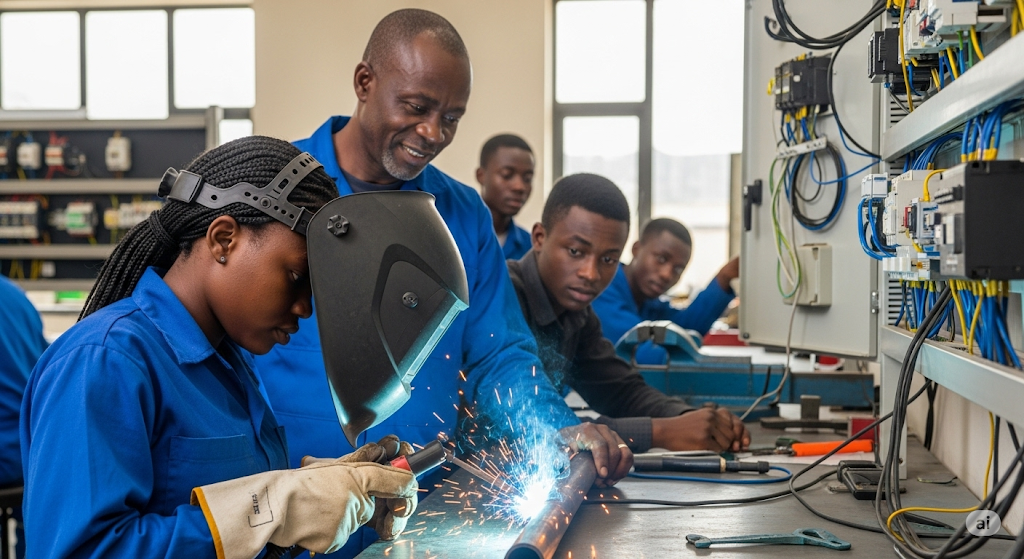
Image 1: A focused group of young Nigerian men and women in a vocational training centre. The image shows a bright, modern workshop. In the foreground, a young woman wearing a protective helmet and welding mask is carefully practising TIG welding on a piece of pipe, sparks flying. Behind her, a qualified instructor in overalls is guiding a young man who is looking at a complex electrical panel. The atmosphere is one of serious learning, skill acquisition, and empowerment.


B. Essential Support Roles: Keeping the Project Moving

Not everyone can be a welder. A project of this magnitude needs a huge team of support staff to function efficiently and safely.

  • Health, Safety, and Environment (HSE): Safety is the number one priority on any world-class construction site. A basic HSE certification (Level 1, 2, and 3) is one of the most valuable entry-level qualifications you can obtain. It opens doors to roles like Safety Officer, Fire Watcher, and Permit-to-Work Coordinator.
  • Logistics and Supply Chain Support: Imagine the sheer volume of materials—pipes, cables, cement, equipment—that need to be received, stored, and delivered to the right location on site at the right time. Roles in materials control, warehouse operation, and logistics coordination are critical.
  • Administration and Document Control: Major projects generate mountains of paperwork, from technical drawings to work permits and reports. Meticulous and organised individuals are needed for administrative support and document control roles to keep the project information flowing correctly.

C. Professional and Technical Roles: The Brains of the Operation

For those with higher education or specialised experience, there are numerous opportunities.

  • Engineering: Graduates in Mechanical, Civil, Electrical, and Chemical Engineering are needed for roles in supervision, quality control, and project management.
  • Quality Assurance / Quality Control (QA/QC): These are the inspectors who ensure that all work, especially welding and installation, meets the required international standards. A certification in QA/QC can lead to a highly respected and well-paid career.
  • IT Support: A modern construction site is heavily reliant on technology, from network connectivity to specialised software. IT professionals are needed to keep these systems running smoothly.

Part 3: Your Four-Step Action Plan – How to Get Hired

Knowing what skills are needed is only half the battle. You now need a concrete plan to make yourself the ideal candidate.

Step 1: Get Certified – Your Proof of Competence

In the industrial world, your word is not enough. You must have official certificates to prove you are trained and competent.

  • Identify Recognised Centres: Invest in your future by enrolling in a reputable vocational training centre. Look for institutions recognised by industry bodies, such as the Nigerian Institute of Welding (NIW). Don’t be tempted by cheap, unaccredited “certificate mills.”
  • Focus on Your Chosen Trade: Decide which skill you want to acquire and pursue the relevant certifications. For HSE, look for qualifications from bodies like NEBOSH or IOSH, which are globally recognised.
  • Document Everything: Keep all your certificates, training records, and qualifications in a neat, professional portfolio.

Step 2: Build a Professional CV – Your Marketing Document

Your Curriculum Vitae (CV) is the first impression a recruiter will have of you. It must be professional, clear, and tailored to the job you want.

  • Keep it Clean and Simple: Use a clear font and a simple layout. Focus on readability. Limit it to one or two pages.
  • Start with Your Contact Details: Your name, phone number, and a professional email address should be at the very top.
  • List Your Certifications First: For industrial roles, your technical certifications are more important than your academic history. List them clearly near the top of your CV.
  • Use Action Words: Describe any experience you have using strong verbs. Instead of “Was part of a team,” write “Collaborated with a team to successfully complete…”
  • Proofread, Proofread, Proofread: A single spelling or grammar mistake can get your CV thrown in the bin. Read it over carefully, and ask someone else to check it for you.

Image 2: A confident, professional young Nigerian woman holding her CV. The image shows a young woman in her mid-20s, dressed in a smart blouse. She is standing against a plain, well-lit background. She is holding a crisp, printed CV and looking directly at the camera with a slight, confident smile. Her expression is one of hope, readiness, and professionalism, embodying the ideal job applicant


Step 3: Look in the Right Places – The Official Channels

To avoid scams, you must use the official recruitment channels.

  • The Main Contractors (EPCs): The primary employer for Train 7 construction is the SCD JV (Saipem, Chiyoda, Daewoo). Monitor their official career websites. Do not pay anyone who claims they can get you a job with them. All official recruitment is free.
  • Community Portals: Liaise with the official community bodies tasked with interfacing on employment. This could be the Finima Capacity Development Committee (FCDC) or the Finima Youth Congress (FYC). They are the official channels for receiving information and submitting CVs for community-specific roles. They will help you filter out fraudulent “agents.”

Step 4: Think Beyond Train 7 – Build a Lifelong Career

This is the most important step of all. Do not view Train 7 as a one-time job; view it as a world-class training ground. The skills you acquire here are not just “Train 7 skills”; they are globally recognised industrial skills.

  • Gain Experience: Once on the project, be a sponge. Learn everything you can. Show up on time, work hard, and maintain a positive attitude.
  • Network Professionally: Build good relationships with your supervisors and colleagues. These connections can lead to future opportunities.
  • The Bigger Picture: A certified industrial welder or a qualified HSE officer from the Train 7 project can go on to work on other major projects in the Niger Delta, in the Nigerian maritime industry, or even internationally. The end of the Train 7 construction phase should be the beginning of your long and successful career, not the end of a job.

Image 3: A wide, inspiring shot of a major industrial construction site at dawn. The image shows the silhouette of a massive industrial plant under construction, similar to the NLNG facility. Cranes reach into the early morning sky, and the intricate network of scaffolding and pipes is visible. The rising sun creates a dramatic orange and purple glow on the horizon, symbolising a new day and new opportunities. The scale of the project conveys a sense of ambition and the vast potential for employment.


Conclusion: Your Future is in Your Hands

The NLNG Train 7 project is a generational opportunity, but it is not a lottery ticket. Success will not be handed to you; it must be earned through preparation, dedication, and strategic action. The doors are open for the youth of Finima in a way they are not for others, but it is up to you to acquire the skills and professionalism needed to walk through them.

Use this guide as your starting point. Invest in yourself by getting certified. Craft a CV that makes you proud. Use the official community channels to find your path. See this not just as a chance to get a job, but as a chance to build a career that will empower you, your family, and your community for decades to come.

The hum of construction on your doorstep is the sound of opportunity knocking. It is time to answer the door.

profile picture

Generate Audio Overview

finima opu ogbo fungu miine festival

The Untold Story of Finima’s Cultural Heritage

Introduction
You may have heard of Bonny Island—a hub for oil exports and energy infrastructure in Nigeria. But nestled quietly on the island’s southern coast is Finima, a community whose rich cultural heritage, history of resistance, and legacy of environmental stewardship are largely untold. This article uncovers the unique story of Finima’s past, present, and future, with a special spotlight on the Buoye Omuso Brown House (BOBH), one of its most revered institutions.

The Early History of Finima
Finima traces its lineage back about 1000 years to the founding ancestors of the Ibani people, the very first settlers before any other Bonny people. Oral traditions and documented history tell of the migration of the Buoye Omuso Brown lineage from Okoloba in the Isedeni Area in Central Ijaw in the present-day Kolokuma Local Government Area of Bayelsa State, eventually establishing Finima as a prominent trading outpost on the Atlantic coast. Early European visitors in the 14th, 15th and 16th centuries documented its strategic maritime location and sophisticated indigenous political systems.

Colonial archives and missionary records confirm Finima’s role in regional commerce, its influence extending well beyond Bonny into the Niger Delta hinterlands. Despite the advent of colonial disruption, Finima maintained its identity through strong family structures, particularly the BOBH.

The Role of Buoye Omuso Brown House
The Buoye Omuso Brown House is not just a family—it is the cultural and historical pillar of Finima. With successive generations of respected leaders, including the recently celebrated Aseme Alabo Dr. Engr. Dagogo Lambert Brown (Kongo XVII), the BOBH has safeguarded Finima’s land rights, oral history, and customary governance.

BOBH also played a major role in negotiating Finima’s interests during oil exploration in the 1950s and later LNG development in the 1990s. Its leadership continues to advocate for equitable resource distribution and environmental conservation.

Finima’s Environmental and Cultural Significance
Beyond its historical depth, Finima is an environmental sanctuary. Home to the Finima Nature Park—managed in partnership with Nigeria LNG—it hosts endangered flora and fauna in a protected mangrove and rainforest ecosystem. This blend of biodiversity and indigenous stewardship makes Finima a model for community-based conservation in Africa.

Annually, the Finima Cultural Festival showcases vibrant traditional dances, masquerades, and Ibani regalia. It draws crowds from Bonny, Port Harcourt, Lagos, and the diaspora. Events such as the Amadabo’s inspection tours, ancestral shrines, and age-grade ceremonies reinforce Finima’s cultural pride and resilience.

Diaspora Links and Present-Day Relevance
Finima’s influence stretches far beyond Nigeria’s shores. Many members of the BOBH and other Finima families have settled across Europe, the Americas, and the Middle East—serving as ambassadors of Ibani culture. Today, digital platforms like https://www.finima.net connect this global diaspora, preserve oral traditions, and mobilise support for local development.

Digital storytelling, photo archives, and recorded oral histories have helped revive interest among young Finima descendants born abroad. Cultural reorientation programmes and heritage tours are now a growing trend.

Watch: Finima Festival Highlights – Colours of Ibani Pride

Conclusion: The Call to Preserve and Protect
Finima’s story is one of endurance—of a people who have weathered colonialism, industrialisation, and environmental threats with dignity. As modernisation and climate change reshape Bonny Island, the heritage of Finima stands as a reminder that tradition and progress must walk hand in hand.

Preserving Finima’s culture means more than celebration—it means education, investment, and respect for the ancestral values that sustain it. Let us honour Finima’s past by shaping a future where its identity thrives.

📌 Call to Action: Support cultural preservation by following Finima.net, sharing this story, and contributing to heritage projects in the community.

side view of a dental chair in a clinic

Call to IOCs and Government: Elevating Healthcare Facilities in Finima for a Healthier Future

Introduction

Finima, a vibrant community in Rivers State, Nigeria, is home to a significant population and hosts several International Oil Companies (IOCs) operating in the Niger Delta region. Despite its strategic importance, Finima’s healthcare infrastructure remains underdeveloped, leaving residents vulnerable to preventable health crises. This blog post is a clarion call to IOCs and the government to prioritise the improvement of healthcare facilities in Finima. By investing in modern clinics, trained personnel, and essential medical supplies, we can transform the health outcomes of this community and set a precedent for corporate social responsibility (CSR) in the region.

The Current State of Healthcare in Finima

IOCs operating in Finima reap immense benefits from the region’s natural resources. With these profits comes a moral obligation to invest in the community’s well-being. Corporate Social Responsibility (CSR) must evolve beyond superficial projects into impactful, long-term initiatives. IOCs operating in Finima reap immense benefits from the region’s natural resources. With these profits comes a moral obligation to invest in the community’s well-being. Corporate Social Responsibility (CSR) must evolve beyond superficial projects into impactful, long-term initiatives.

Finima’s healthcare system is plagued by numerous challenges, including:

  1. Inadequate Infrastructure: Existing health centres are often dilapidated, with insufficient space and outdated equipment. Many lack basic amenities like clean water and electricity.
  2. Shortage of Medical Personnel: There is a severe lack of qualified doctors, nurses, and specialists, forcing residents to travel long distances for critical care.
  3. Limited Access to Medications: Pharmacies and clinics frequently run out of essential drugs, leaving patients without treatment for common ailments like malaria and hypertension.
  4. Poor Emergency Services: The absence of ambulances and emergency response systems means that life-threatening conditions often go untreated.

These deficiencies disproportionately affect vulnerable groups, including women, children, and the elderly, exacerbating health disparities in the community.

The Role of International Oil Companies (IOCs)

IOCs operating in Finima, such as Shell, Chevron, and Total, have a moral and ethical obligation to contribute to the well-being of their host communities. Their operations often bring environmental and health challenges, making it imperative for them to invest in sustainable healthcare solutions. Here’s how IOCs can help:

1. Funding Modern Healthcare Facilities

IOCs should allocate a portion of their CSR budgets to build and equip state-of-the-art hospitals and clinics in Finima. These facilities should include:
– Maternity wards for safe deliveries.
– Laboratories for accurate diagnostics.
– Emergency units for critical care.

2. Training and Employing Local Healthcare Workers

Investing in education and training programmes for local residents can create a pipeline of skilled healthcare professionals. IOCs can sponsor scholarships for medical students and facilitate partnerships with teaching hospitals.

3. Providing Essential Medical Supplies

Regular donations of medications, vaccines, and medical equipment can bridge the gap in supply shortages. IOCs can also partner with NGOs to organise medical outreach programmes.

4. Environmental Health Initiatives

Given the link between oil exploration and health issues like respiratory diseases, IOCs must implement measures to reduce pollution and provide specialised care for affected individuals.

The Government’s Responsibility

While IOCs play a critical role, the government at both state and federal levels must also step up. Key actions include:

1. Policy Implementation and Enforcement

The government should enforce existing laws that mandate IOCs to contribute to community development. Policies like the Niger Delta Development Commission (NDDC) should be revitalised to ensure funds are used effectively.

2. Building Public Healthcare Infrastructure

Government-funded hospitals and primary health centres should be established in Finima, equipped with modern facilities and staffed by qualified personnel.

3. Strengthening Health Insurance Schemes

Expanding programmes like the National Health Insurance Scheme (NHIS) to cover more residents can reduce out-of-pocket expenses and improve access to care.

4. Community Engagement

Officials should collaborate with community leaders to identify pressing health needs and tailor interventions accordingly.

The Way Forward: A Collaborative Approach

Improving healthcare in Finima requires a multi-stakeholder approach:

  1. Partnerships Between IOCs and Government: Joint initiatives can pool resources and expertise for maximum impact. Public-Private Partnerships (PPPs) can pool resources from IOCs and the government to fund healthcare projects, combining efficiency with accountability.
  2. Community Involvement: Residents should be included in planning and decision-making to ensure solutions are culturally appropriate and sustainable.
  3. Transparency and Accountability: Funds and projects must be monitored to prevent mismanagement, with regular progress reports shared with the public.
  4. Multi-Stakeholder Task Forces: Creating committees with representatives from IOCs, government, and NGOs can streamline efforts and monitor progress transparently.


The Ripple Effects of Improved Healthcare

Investing in Finima’s healthcare yields far-reaching benefits:

  1. Healthier Population: Reduced disease burden means longer, more productive lives for residents.
  2. Economic Growth: A healthy workforce attracts businesses and boosts local economies.
  3. Reputation Boost: IOCs and the government can rebuild trust by proving their commitment to social responsibility.


Conclusion

The call to upgrade Finima’s healthcare is not just about fixing clinics—it’s about justice, equity, and sustainable progress. IOCs must move beyond profit-centric mindsets, and the government must prioritise its citizens’ well-being. Together, they can turn Finima into a model of community-driven development. The time to act is now. For Finima, for the Niger Delta, and for generations to come, let’s transform healthcare from a privilege into a fundamental right.

Finima’s residents deserve access to quality healthcare, just like any other community. By heeding this call, IOCs and the government can save lives, boost productivity, and foster goodwill in the region. Let’s work together to build a healthier, brighter future for Finima.

Join the conversation: Share your thoughts and ideas on how we can improve healthcare in Finima. Tag relevant stakeholders and use the hashtag #HealthyFinima to amplify this call to action!


This blog post is a starting point for advocacy. With collective effort, we can turn these recommendations into reality.

Page 3 of 8
1 2 3 4 5 8