Historic Royal Condolence Visit Strengthens Niger Delta Kingdoms’ Centuries-Old Alliance
By Victoria Chambers, Senior Correspondent
Published: Saturday, 5 April 2026 | Opobo Kingdom, Rivers State
A Ceremonial Convergence of Tradition and Diplomacy
OPOBO KINGDOM — In a meticulously choreographed display of royal protocol and deep cultural reverence, His Royal Highness Aseme Alabo Engr. Dr. Dagogo Lambert Brown, Kongo XVII, the Amadabo of Finima, arrived at the historic Opobo Kingdom on Saturday morning, 4 April 2026. His visit, ostensibly a condolence mission following the transition of Opobo’s revered monarch, transformed into a significant diplomatic event that may well redefine inter-kingdom relations in Nigeria’s Niger Delta region for the coming decade.
The Finima monarch’s delegation, comprising not only the Council of Alapu but also three senior chiefs representing Finima’s major war canoe houses, arrived via a flotilla of traditionally adorned vessels—a deliberate nod to the maritime heritage both kingdoms share. Their reception by Alabo Edwin Adonye Cockeye Brown, Chief and Head of the Cockeye Brown War Canoe House (Kala Omuso), followed protocols unchanged since the 19th century, complete with libation pouring, cannon salutes (using blank charges), and the exchange of specially woven royal cloth.
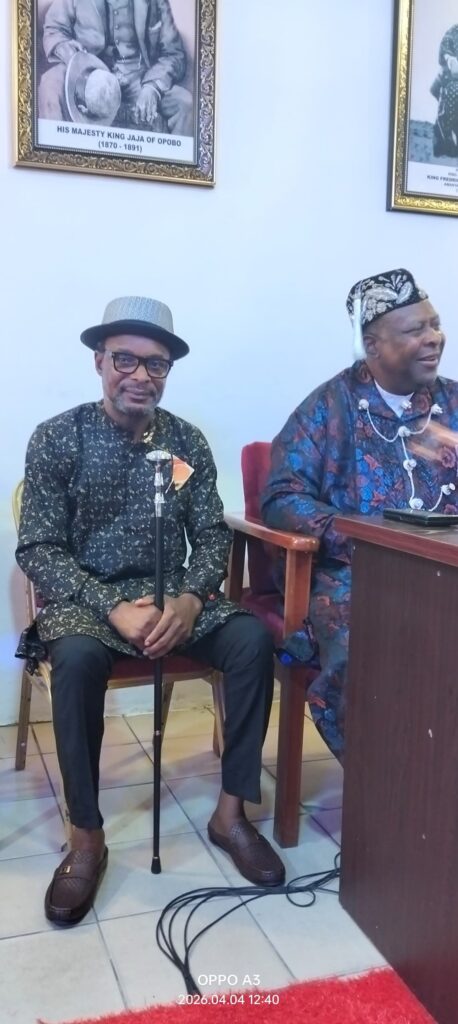
“This isn’t merely a condolence visit,” observed Professor Ibrahim Okoro, a historian of Niger Delta kingdoms at the University of Port Harcourt, in an interview following the event. “What we witnessed today is the reactivation of a strategic alliance that dates back to the pre-colonial era. The symbolism—the choice of traditional vessels over motorcades, the specific war canoe houses represented, the gifts exchanged—every detail speaks to a conscious effort to reinforce historical bonds at a time when modern political structures often overshadow traditional authority.”
The Historical Backdrop: From Trade Routes to Royal Kinship
To understand the significance of Saturday’s visit, one must appreciate the intricate tapestry of history connecting Finima and Opobo. Both kingdoms emerged from the complex political landscape of the Niger Delta’s city-states during the 18th and 19th centuries. Finima, originally part of the Bonny Kingdom, and Opobo, founded by the legendary King Jaja after his exile from Bonny in 1887, developed parallel systems of governance centred on the “Amanyanabo” (king) and “Amadabo” (chief) structures, with powerful merchant houses operating war canoes that controlled trade routes.

The personal connection between the Brown and Jaja lineages forms the emotional core of this relationship. Historical records from the National Archives in Enugu indicate that during King Jaja’s exile to Accra in 1891 (before his eventual deportation to the West Indies), several Finima chiefs provided clandestine support to the Opobo monarchy, ensuring continuity of governance. This act of solidarity during a period of extreme vulnerability, according to oral historians, established a debt of honour that has been acknowledged through generations of ceremonial visits.
“The 1891 support wasn’t documented in British colonial papers for obvious reasons,” explained Chief Anthony Briggs, the Opobo Kingdom’s official historian. “But in our oral traditions, it’s recited as part of the installation ceremonies for every new Amanyanabo. The Finima people risked their own standing with the colonial administration to help Opobo maintain its sovereignty. Saturday’s visit by the Amadabo of Finima is, in part, a reciprocal acknowledgment of that historical courage.”
The Condolence Ceremony: Protocol as Political Language
The formal condolences were extended in the newly renovated Opobo Council Hall, a structure originally built in 1923 but recently restored using traditional materials and techniques. The Finima delegation presented seven symbolic gifts, each rich with meaning:
- A specially carved ivory tusk representing the wisdom of the departed monarch.
- Seven yards of “George” cloth (the traditional fabric of Niger Delta royalty).
- A bound volume containing handwritten condolences from every Finima chieftaincy house.
- A historic map from 1902 showing Opobo and Finima trade routes.
- A silver-bound Bible (reflecting King Jaja V’s documented Christian faith).
- A living iroko sapling to be planted in the royal garden as a growing memorial.
- A sealed proposal for cultural exchange programmes between the kingdoms’ youth.
“The gifts tell a story beyond mourning,” noted Dr. Amina Yusuf, an anthropologist specialising in Niger Delta material culture. “The map speaks to shared economic history, the Bible acknowledges personal faith, the sapling suggests future growth, and the exchange proposal looks toward intergenerational continuity. This is condolence as nation-building.”
Alabo Edwin Adonye Cockeye Brown, serving as official host, emphasised the shared ancestry between the houses. “The Brown lineage in Finima and the Cockeye Brown house in Opobo aren’t merely namesakes,” he declared during his welcome address. “We are branches of the same tree, watered by the same rivers, answering to the same ancestral call. When Finima mourns with Opobo, we mourn with our own blood.”
The New Monarch’s Response: Vision for a Collaborative Future
His Majesty King-Elect Charles Douglas Mac-Pepple Jaja (Jeki VI), who will be formally crowned in an elaborate month-long ceremony beginning 15 June 2026, received the condolences with visible emotion. In his response—delivered partly in the Opobo dialect and partly in English for the benefit of younger attendees—the monarch-elect outlined a vision for practical collaboration.
“While we mourn my predecessor, the great Jeki V, we must also look forward,” King-Elect Jaja VI stated. “The challenges facing our region—environmental remediation from oil pollution, youth unemployment, coastal erosion, educational gaps—require united action. The historical alliance between Opobo and Finima must evolve into a development partnership.”
Specifically, the monarch-elect proposed:
- A joint cultural heritage trust to preserve historical sites in both kingdoms.
- A scholarship programme for outstanding students to study maritime technology.
- Collaborative advocacy for better implementation of the Niger Delta Development Commission’s projects.
- Annual youth exchanges focusing on traditional canoe building and navigation.
- A standing committee of chiefs from both kingdoms to meet quarterly.
“The era when traditional rulers were merely ceremonial is over,” Jaja VI asserted. “We have moral authority, historical legitimacy, and deep community connections. By combining Opobo’s experience in international engagement—dating back to King Jaja’s trade with European firms—with Finima’s engineering expertise and modern educational institutions, we can create a model for traditional governance in the 21st century.”
Regional Implications: A Shifting Landscape of Traditional Authority
The Finima-Opobo meeting occurs against a backdrop of significant realignment among Niger Delta kingdoms. In February 2026, the Kalabari, Okrika, and Bonny kingdoms announced a tripartite council for economic cooperation. The Nembe and Brass kingdoms have recently revived their pre-colonial defence pact. Analysts suggest that traditional rulers, recognising limitations in state and federal government responses to regional issues, are increasingly turning to historical alliances for practical solutions.
“These kingdoms aren’t seeking secession or challenging the Nigerian state,” clarified political scientist Dr. Felix Nwankwo. “Rather, they’re creating supplementary governance structures that can operate where formal institutions are weak. The Niger Delta has a long tradition of city-states functioning as autonomous entities within larger political systems. What we’re seeing is a modern adaptation of that model.”
The Finima-Opobo alliance is particularly noteworthy because it bridges what historians call the “Eastern and Western Delta” traditions. Opobo represents the more cosmopolitan, externally engaged model (historically trading directly with Europeans), while Finima represents the deeply rooted, engineering-focused tradition (with strong ties to Nigeria’s petroleum industry). Their collaboration could create a powerful synthesis.
Environmental and Economic Dimensions
No discussion of Niger Delta kingdoms can ignore the environmental crisis. Both Opobo and Finima territories have suffered severe oil pollution, mangrove destruction, and coastal erosion. During the visit, both monarchs explicitly addressed this issue, announcing plans for a joint ecological survey conducted by independent international experts.
“The oil companies and government agencies produce reports, but we need assessments we trust,” explained Engr. Dr. Dagogo Lambert Brown, whose background includes petroleum engineering. “We will commission scientists from universities in Ghana and South Africa to map the damage in both kingdoms and create a restoration plan. Then we’ll present unified demands for remediation.”
Economically, both kingdoms are exploring alternatives to fossil fuel dependency. Opobo has invested in aquaculture projects and is developing historical tourism around King Jaja’s legacy. Finima has established technical training institutes in partnership with German engineering firms. Their combined approach—heritage tourism plus technical education—could offer a development model for other coastal communities.
The Personal Dimension: Monarchs as Relatives
Beyond the politics and economics, Saturday’s event highlighted the personal connections between the ruling families. King-Elect Jaja VI revealed that his mother and the Finima monarch’s wife are cousins through the Kalabari royal line—a relationship previously known only within family circles.
“We aren’t just allies; we’re family,” Jaja VI said during a lighter moment in the proceedings. “When I was studying in the United Kingdom, the Amadabo of Finima, then still a practising engineer, visited me and took me to dinner. He advised me to complete my education but never forget the dialect of our rivers. That personal mentorship across kingdom lines is what our tradition is really about.”
This familial element adds a layer of resilience to the political alliance. As Chief Margaret Thompson, a gender rights advocate and member of Opobo’s Council of Alapu, noted: “When relationships are written in both official documents and family Bibles, they withstand different pressures. These kingdoms have intermarried for generations. That creates obligations that mere treaties don’t.”
Ceremonial Details: The Unspoken Language of Tradition
The day’s events followed a precise ceremonial schedule that itself communicated messages:
06:30 — Finima delegation departs via traditional canoes (signalling respect for maritime tradition)
08:00 — Arrival at Opobo’s historic “Waterfront Palace” landing (acknowledging Opobo’s sovereignty)
08:15 — Libation pouring using water mixed from both kingdoms’ rivers (symbolic unity)
09:00 — Silent procession to the royal cemetery (shared mourning)
10:30 — Formal council meeting (governance collaboration)
12:00 — Community feast with dishes from both kingdoms (cultural integration)
14:00 — Private meeting between monarchs (personal bond reinforcement)
16:00 — Joint prayer service at St. Paul’s Cathedral (spiritual unity)
17:30 — Departure with reciprocal gifts (balanced exchange)
Every element was photographed and videographed by a joint media team, with footage to be archived in both kingdoms’ historical collections and edited into educational materials for schools.
The Road Ahead: From Ceremony to Institution
The true test of Saturday’s visit will be its institutional legacy. Both monarchs announced the creation of a “Finima-Opobo Joint Secretariat” to be headquartered in a renovated historic building midway between the kingdoms. The secretariat will have a small professional staff and rotate leadership annually between the kingdoms.
Initial projects will include:
- Digital archiving of both kingdoms’ historical records
- A joint apprenticeship programme in traditional boat building
- Advocacy for the inclusion of Niger Delta history in the national curriculum
- An annual “King Jaja Memorial Lecture” alternating between Finima and Opobo
- A women’s cooperative for marketing traditional textiles to international markets
“By next year, we want tangible outcomes,” the Finima monarch stated in his closing remarks. “Not just another memorandum of understanding, but actual schools built, scholarships awarded, environmental projects commenced. Our ancestors formed alliances for survival and prosperity. We must honour them by making this alliance work for today’s challenges.”
Scholarly Perspectives: What This Means for Traditional Governance
Academic observers are particularly interested in how this alliance navigates Nigeria’s complex legal landscape. Traditional rulers exist within a constitutional framework that doesn’t explicitly define their powers. Successful cross-kingdom collaborations could establish precedents for how traditional authority complements democratic governance.
“Section 7 of the 1999 Constitution deals with local governments, not kingdoms,” explained constitutional lawyer Prof. Chinedu Obi. “But there’s constitutional silence, not prohibition. If kingdoms like Finima and Opobo create development partnerships that deliver services—say, building schools or managing environmental projects—they might establish a new model of subsidiary governance. The key will be collaboration with state governments, not competition.”
Other kingdoms are watching closely. The Oba of Benin has reportedly expressed interest in the educational exchange model. The Sultan of Sokoto’s office has requested details about the joint secretariat structure for potential adaptation in northern emirates.
Conclusion: Mourning as a Catalyst for Renewal
What began as a condolence visit for a departed monarch evolved into a blueprint for collaborative traditional governance. By anchoring their future cooperation in deep historical ties, Finima and Opobo have created a partnership that appears resilient, culturally grounded, and practically oriented.
As the Finima delegation’s canoes disappeared into the sunset-lined creeks, Opobo’s council members expressed unanimous optimism. “Today wasn’t about ending something,” concluded Chief Cockeye Brown. “It was about beginning something new with old wisdom. King Jaja V would have approved.”
The departed monarch’s favourite proverb, recited by both leaders during the ceremonies, seems fitting: “A river that flows alone cuts a shallow channel; rivers that join become a delta that nourishes many lands.”
For the people of Finima and Opobo—and potentially for traditional governance across Nigeria—Saturday’s historic visit may indeed mark the convergence of rivers into a more nourishing delta.
Additional Reporting by Michael Adekunle in Port Harcourt
Historical consultation provided by the Niger Delta Kingdoms Research Collective
Photography by the Opobo Royal Media Office
Editor’s Note: This report is based on direct observation of events, interviews with participants, and historical research. All royal titles and protocols were verified with kingdom historians.
This article expands on the original event, providing detailed insights into the historical context, ceremonial significance, and future implications of the visit while maintaining a journalistic tone suitable for publication.
You must be logged in to post a comment.